Dal Lake
Dal Lake: A Complete Guide
The shape of the lake, the ghats you arrive through, the dawn market, how to behave on a shikara, and when the light is worth getting up for.
Dal Lake is not one open sheet of water. It is a set of basins divided by causeways, threaded with channels, edged by houseboats on one side and by floating gardens and water villages on the other. Understanding that layout is what turns a shikara ride from a loop into an afternoon worth having. This guide covers the shape of the lake, the ghats, the market, how to behave on the water, and when the light is best.
The layout of the lake
The boulevard runs along the south-eastern shore, below the Shankaracharya hill, and this is where almost all the houseboat moorings and the public ghats are. Behind the line of boats, causeways and embankments split the lake into basins, connected by channels narrow enough that two shikaras have to pass carefully.
Out in the middle and to the north are the inhabited parts of the lake: reclaimed plots and floating gardens where vegetables are grown on rafts of weed and mud, houses built on islands, shops, a post office, mosques and schools, all reached only by boat. Further north the water opens again and connects through to Nigeen Lake.
Two built landmarks sit out on the water — the small garden islands with their chinar trees — and they are the usual turning point for a short ride. The lake is shallow across much of its area, which is why the shikaras are flat-bottomed and paddled rather than rowed.
The ghats
Access to the lake is through numbered ghats along the boulevard. They are simple stone steps down to the water with shikaras waiting at them, and they are how you reach almost every houseboat. When you book a stay you are given a ghat number, and that number is the single most useful piece of information you will carry.
Taxis know the ghats by number. So do the boatmen. If you are arriving with luggage, message your host when you land, tell them the ghat, and wait there rather than walking along the boulevard looking for your boat — from the road the boats all look alike, and yours may be behind three others.
The floating vegetable market
Before dawn, growers from the floating gardens bring produce out in long flat boats and trade among themselves in one of the inner basins. Boats nose together, bunches of greens and lotus stems change hands, money is counted, and by full daylight it has dispersed.
It is a working wholesale market, not a display, and that is exactly why it is worth seeing. To get there you need to leave your houseboat before first light — arrange the shikara with your host the night before — and reckon on twenty to forty minutes of paddling depending on where you are moored. Take something warm; it is cold on the water at that hour in any season.
On the way back, ask the boatman to go through the channels between the gardens rather than straight across the open water. The lake at seven in the morning, with the gardens being worked and the first children going to school by boat, is the part most visitors miss.
Shikara etiquette
A shikara is a paddled wooden boat with a canopy and cushions, crewed by one or two boatmen. It is transport as much as recreation: it is how people on the lake get to work, to school and to market. A few things make the experience better.
- Agree the route and the duration before you get in, not once you are out on the water. Say where you want to go — the market, the gardens, the islands — and for how long.
- Settle the price first, and settle whether that includes the return. If your houseboat arranges the ride, this is usually handled for you.
- Say no clearly to the vendor boats. A polite, firm refusal is understood and respected; a vague answer means they will stay alongside.
- Decline the shop stop if you do not want it. Being taken to a workshop mid-ride usually means a commission, and you can simply say you would rather stay on the water.
- Ask before photographing people on the lake, particularly at the market and around the houses.
- Nothing goes in the water. The lake is under long-term conservation work and everything on it depends on the water staying clean.
- Tip the boatman if the ride was good. It is normal and it is appreciated.
Shikara rides
Arrange a ride with your stay
A shikara ride can be added to any houseboat booking, including a pre-dawn start for the floating market. Rates on request, confirmed with your dates.
Houseboats on Dal Lake
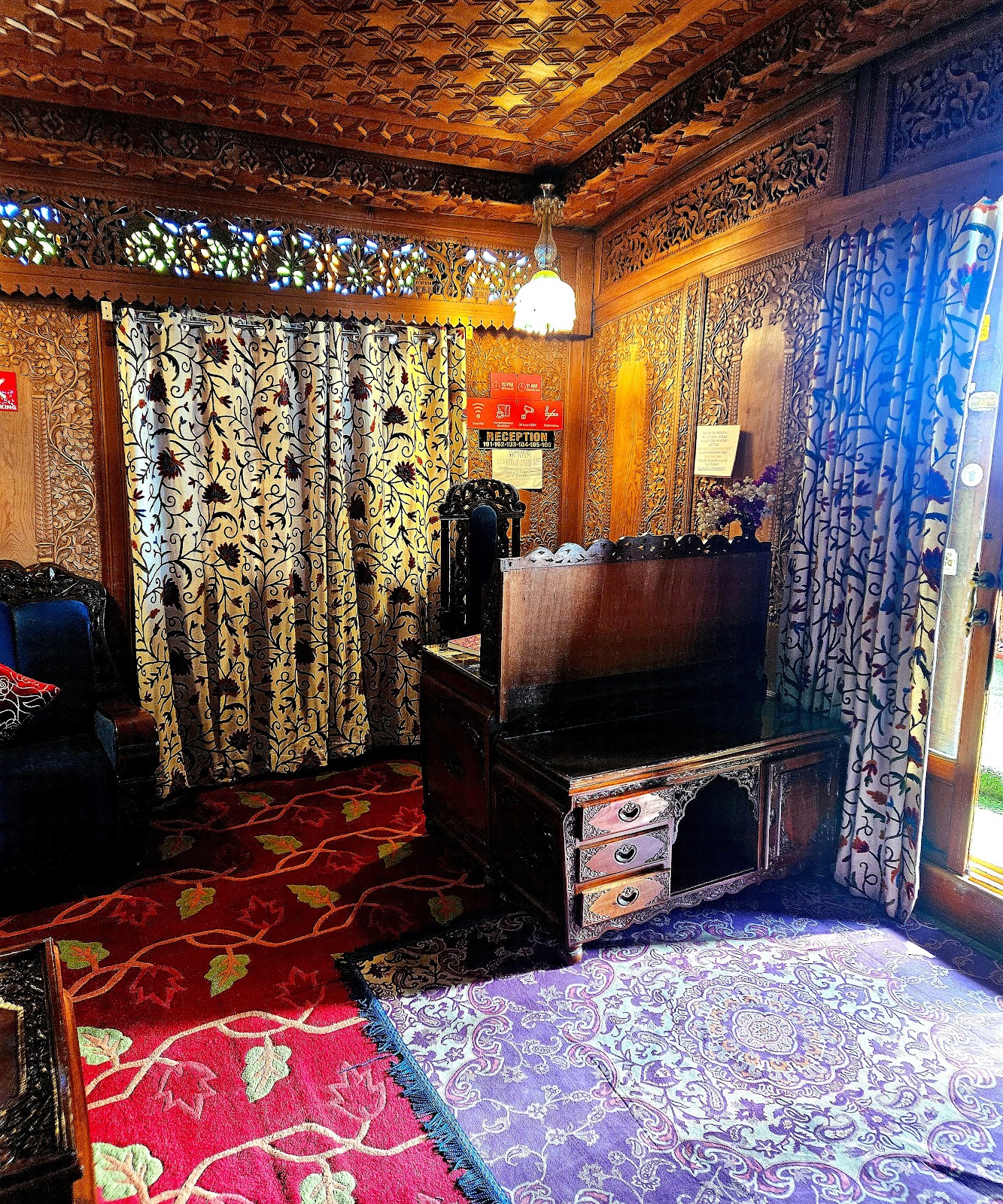
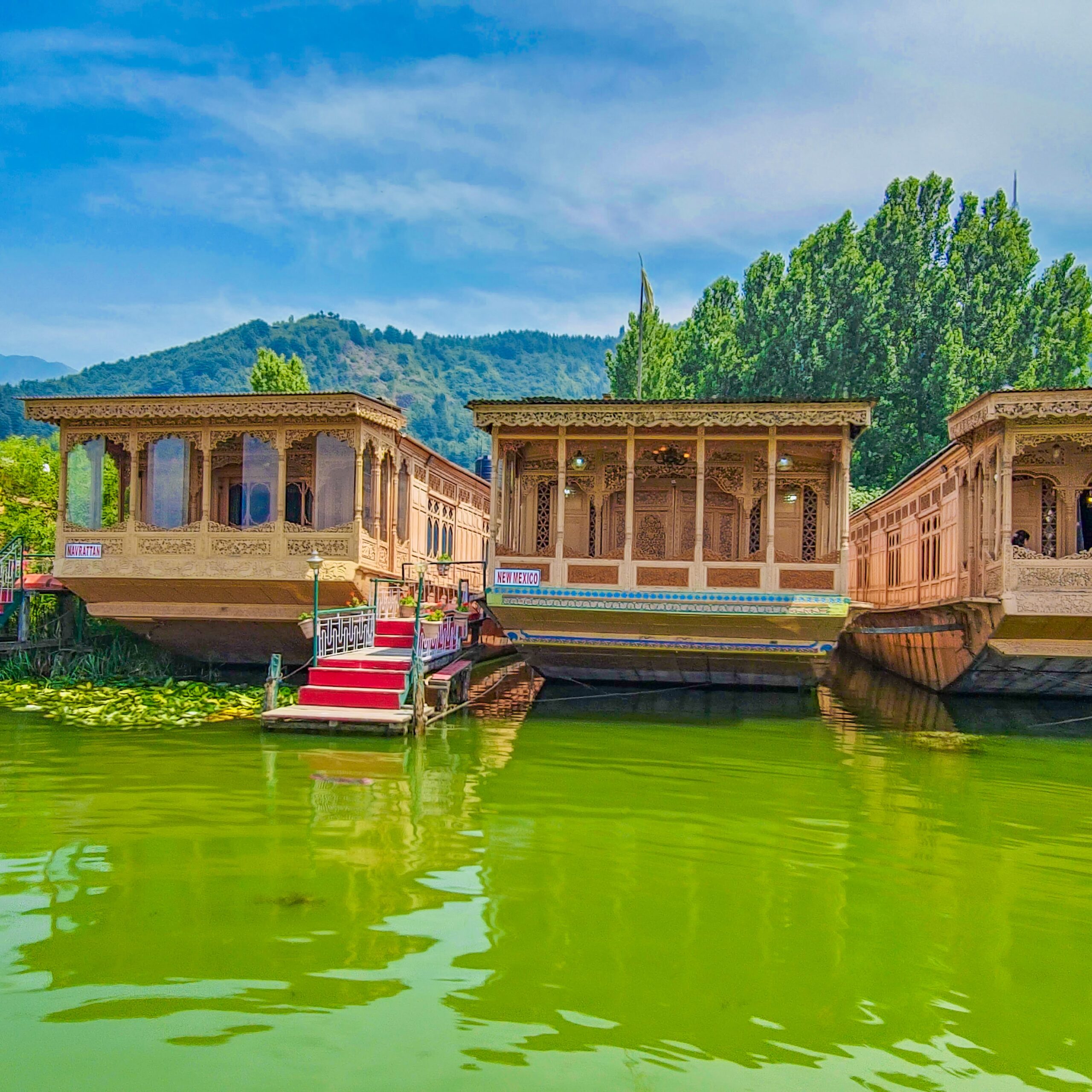
Most of the boats are moored along the eastern shore in rows, with their carved front verandahs facing the open water and a walkway or a narrow channel behind. 657 houseboats are registered on Dal Lake with the Kashmir Houseboat Owners Association. We know six of them personally, and others can be arranged on request.
Position on the lake matters more than people expect. A boat in the front row has open water in front of it; a boat in the second or third row looks onto another boat. A mooring near a ghat is convenient and slightly busier; one further out is quieter and a longer paddle. None of this appears in a category label, which is why we talk about specific boats rather than categories. Our guide on houseboats in Kashmir explains how the boats themselves are built.
The lake and its condition
Dal Lake has shrunk over the last century, and weed growth, silt and encroachment are long-standing problems. Dredging, de-weeding and sewage interception work go on continuously, run by the state authorities, and you will see the machinery at work in some of the basins.
This matters to a visitor in two ways. First, some parts of the lake are closed off or under work at any given time, so the exact route of a ride varies. Second, the water you are floating on is the livelihood of everyone you meet on it: the growers, the boatmen and the houseboat families. Keeping waste out of it is not a gesture. Nothing goes over the side of a houseboat or a shikara, and anything you bring out with you comes back with you.
Photography and the light
The lake changes completely through the day, and two windows are worth planning around.
First light to about an hour after sunrise. Mist on the water, flat reflections, the market, and boats leaving the ghats. This is the best hour on Dal Lake by a wide margin, in every season. In autumn and winter the mist can be thick enough to hide the far shore entirely.
The last hour before sunset. Warm light along the Zabarwan hills, silhouettes of shikaras, and the houseboats lit from the front. Afterwards the boulevard lights come on and the reflections are worth staying out for.
Midday is the weakest time: the light is flat and hard, and the lake is at its busiest. Use it for the gardens or the old city instead, and come back to the water in the afternoon. In summer the lotus beds photograph best in the early morning, before the sun is high and while the flowers are still open.