Travel guide
Kashmir Travel Guide
Seasons, arrival, where to stay and how to get around Srinagar and the valley, written from the lakes rather than from a brochure.
Kashmir rewards a little planning. The valley is small enough to cross in a day, but the season you choose changes almost everything about the trip: what is open, what the weather does, how busy the lakes are and how a houseboat feels to sleep on. This guide gathers what we are asked most often, and links out to the detailed guides underneath it.
Best time to visit, by season
There is no single best month. Each season in Kashmir is genuinely different, and the right one depends on whether you want gardens, snow, or quiet water.
Spring, roughly March to May. Almond and cherry blossom first, then the tulip garden below the Zabarwan hills, which opens for a few weeks around late March and April. Days are mild, nights still cool, and the lakes are clear after the winter. This is one of the busiest stretches of the year.
Summer, roughly June to August. Warm days, cool evenings, and the lotus beds on Dal Lake in flower through the height of summer. Srinagar is the escape from the heat of the plains, so hotels and houseboats fill up, particularly through school holidays.
Autumn, roughly late September to November. The chinar trees turn, the light gets long and low, and visitor numbers drop off after the middle of October. Mornings are cold. For photographers this is often the most rewarding season on the water.
Winter, December to February. Snow in the valley and heavy snow in Gulmarg. The coldest period, known locally as Chillai Kalan, runs for about forty days from late December. Fewer visitors, lower rates, and houseboats heated with bukharis. Roads and flights can be disrupted, so leave slack in your plans.
How to reach Kashmir
Most visitors fly. Srinagar International Airport sits south-west of the city and is served by direct flights from Delhi and other Indian cities, with connections onward. From the terminal to the lakes is a short drive by taxi; prepaid counters operate at the airport, and hotels and houseboats can arrange a pickup if they know your flight.
By road, the National Highway from Jammu through the Banihal tunnel is the main artery into the valley. It is a long drive and subject to closures in bad weather or during landslide season. By rail, the valley line runs between Baramulla, Srinagar and Banihal, and rail access from the rest of the country has been extended northwards in stages; check current through services before you plan a train-only journey.
The full detail, including what happens between the ghat and the boat, is in our guide on how to reach Srinagar.
Where to stay
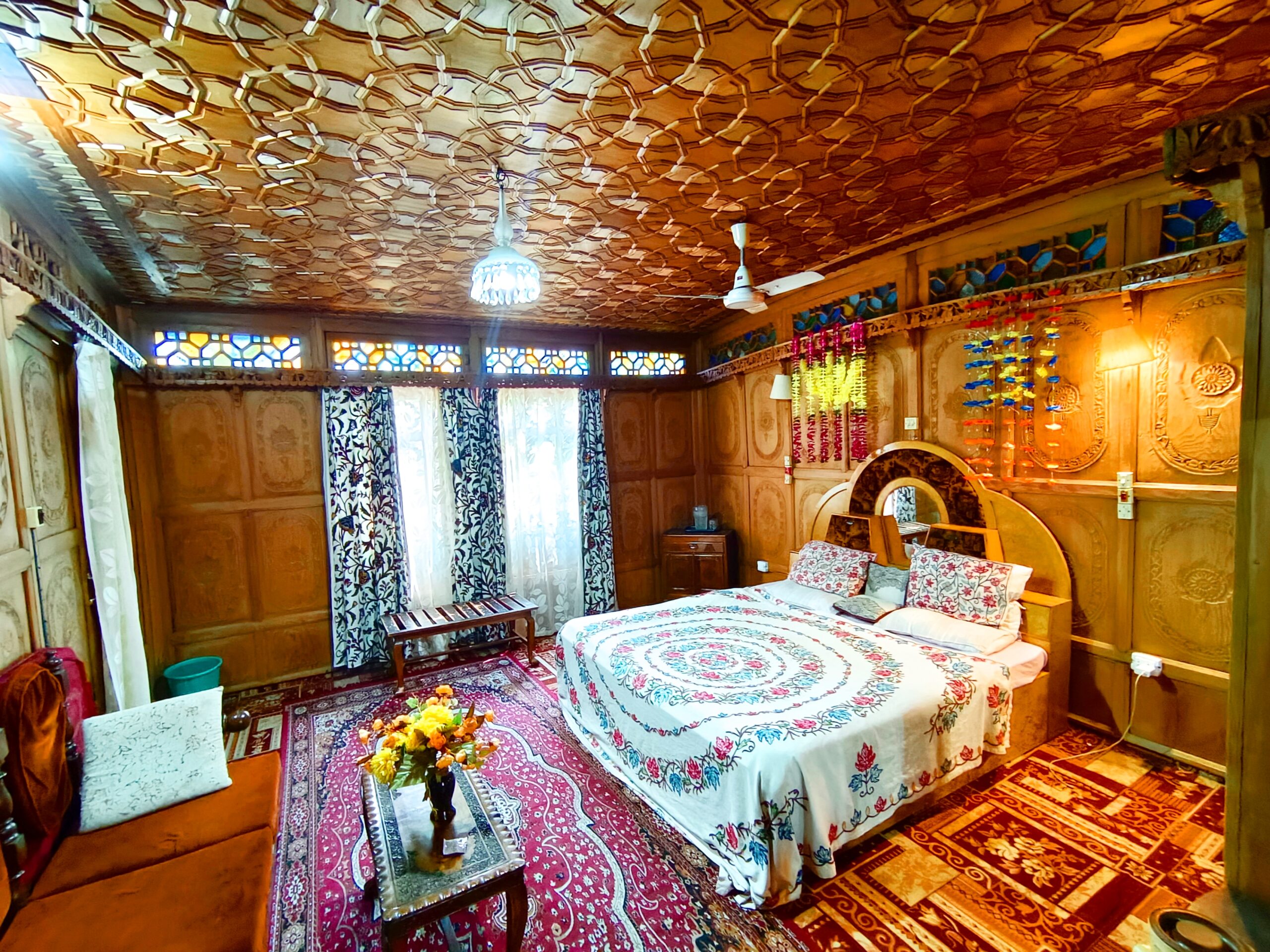
Srinagar gives you three broad choices. A houseboat on Dal Lake or Nigeen Lake, a hotel on the boulevard or in the newer parts of the city, or a guesthouse. A houseboat is not a novelty room: it is a wooden building moored on water, with a verandah at the front, a sitting room, a dining room and bedrooms off a corridor, looked after by the family who own it.
Dal Lake is the larger, better-known lake, close to the boulevard, the gardens and the old city. Nigeen Lake is quieter, with fewer passing boats and a slower feel. Both are within the city. Our guide on Dal Lake or Nigeen Lake sets the two side by side, and houseboats in Kashmir explains how the boats are built and what a stay includes.
We know six houseboats on Dal Lake personally. Beyond those, 657 houseboats are registered on Dal Lake with the Kashmir Houseboat Owners Association, and we can arrange a stay on others on request.
Houseboat stays
See the houseboats we work with
Categories, rooms, facilities and location on the lake, with rates sent for your dates. We never publish a nightly price, because it depends on the boat, the room, the season and the length of your stay.
Getting around
Within Srinagar, taxis and autorickshaws cover the city, and the lakes are crossed by shikara. A shikara is a paddled wooden boat with a canopy; it is transport as much as sightseeing, and it is how you reach most houseboats from the ghats along the boulevard and at Nigeen.
For day trips out of the city, Gulmarg, Pahalgam, Sonamarg and Yusmarg are all within a few hours by road and are usually done as a full day with a hired car and driver. Shared transport exists but is slow. If you have three or four days, plan one long day out and keep the rest for the city and the lakes.
Walking is worth it in two places only: the boulevard along Dal Lake, and the lanes of the old city. Everywhere else in Srinagar is spread out over slopes and long shore roads, and a car with a driver for a half-day costs less trouble than it saves. Our guide to things to do in Srinagar gives rough distances from the lakes for each of the main sights.
What to pack
- Layers in every season. Evenings on the water are colder than the day suggests, even in summer.
- A warm jacket, gloves and proper shoes for winter, and something waterproof for spring.
- Shoes you can slip off easily. You will take them off often, on boats and in homes.
- Modest clothing for mosques and shrines, and a scarf for covering your head at Hazratbal and the Jamia Masjid.
- Sunscreen and sunglasses. The altitude and the reflection off the water are stronger than they feel.
- Cash. Card acceptance is patchy on the water and in the old city.
- Any medication you rely on, with a little spare in case weather delays your return.
The rest of the guides
Each of these goes deeper than the summary above. They are written for people who are actually coming, not for people browsing.
- Houseboats in Kashmir — what a houseboat is, how they are built, room types, what a stay includes and how to behave as a guest.
- How to book a houseboat — the booking sequence, what to confirm in writing, and the common ways travellers get caught out.
- Dal Lake or Nigeen Lake — which of the two suits your trip.
- Best time to visit Kashmir — a month-by-month table of weather, crowds and what is open.
- Things to do in Srinagar — the gardens, the old city, the shrines and the viewpoints, with rough distances from the lakes.
- Dal Lake guide — the layout of the lake, the ghats, the floating market and shikara etiquette.
- How to reach Srinagar — air, road and rail, the airport transfer and the last stretch by water.
If you would rather just ask, send us your dates and the number of people travelling and we will tell you what is available and what it costs.