Getting there
How to Reach Srinagar
Flights, the highway from Jammu, the valley railway, the airport transfer, and the last few minutes from the ghat to the boat.
Srinagar sits in a valley ringed by mountains, which shapes every way of getting there. Almost everyone flies. The road in is long and weather-dependent, the railway reaches the valley but the network beyond it has been built in stages, and the last part of the journey — from a lakeside ghat to your houseboat — happens by boat. This guide covers all four legs.
By air
Srinagar International Airport lies south-west of the city and is the normal way in. It is served by direct flights from Delhi and from several other Indian cities, with onward connections from most major hubs. Flight times from Delhi are short — well under two hours — so a morning departure has you on the water by lunchtime.
Two things to know. First, it is a sensitive airport with thorough security: allow extra time on departure, expect your checked baggage to be screened before you enter the terminal, and carry photo identification. Second, winter weather causes delays and cancellations, so never book a same-day onward international connection out of Delhi in January or February.
Arrivals are straightforward. Prepaid taxi counters operate at the airport, and your houseboat can arrange a pickup if it has your flight number. From the terminal to the Dal Lake boulevard is a short drive, usually well under an hour outside of peak traffic; Nigeen is a few minutes further.
By road
The main road approach is the National Highway from Jammu, which climbs into the valley through the Banihal tunnel. It is a long drive — a full day with stops — and it passes through Ramban and Banihal on a route that has been under improvement work for years. Landslides in the monsoon and snow in winter both close it from time to time.
If you are driving or taking a bus, start early, plan on the journey taking longer than the map suggests, and check whether the highway is open on the day. One-way traffic restrictions are sometimes in force. Taxis for the full Jammu to Srinagar run are readily available, and shared vehicles are cheaper and slower.
The other road route, over the Zoji La pass from Ladakh, is seasonal and only open in the warmer months. It is a spectacular drive rather than a practical one.
By rail
The Kashmir valley has its own railway line, running between Baramulla, Srinagar and Banihal, with a station serving Srinagar on the southern edge of the city. Rail access from the rest of the country has been extended northwards in stages through the Himalayan section towards Katra, so the through options have changed more than once in recent years.
Because of that, check current services and timings before you plan a rail journey rather than relying on an older account. Trains within the valley are inexpensive, and locals use them, but for a visitor arriving from outside Kashmir they are rarely the fastest route.
The airport transfer
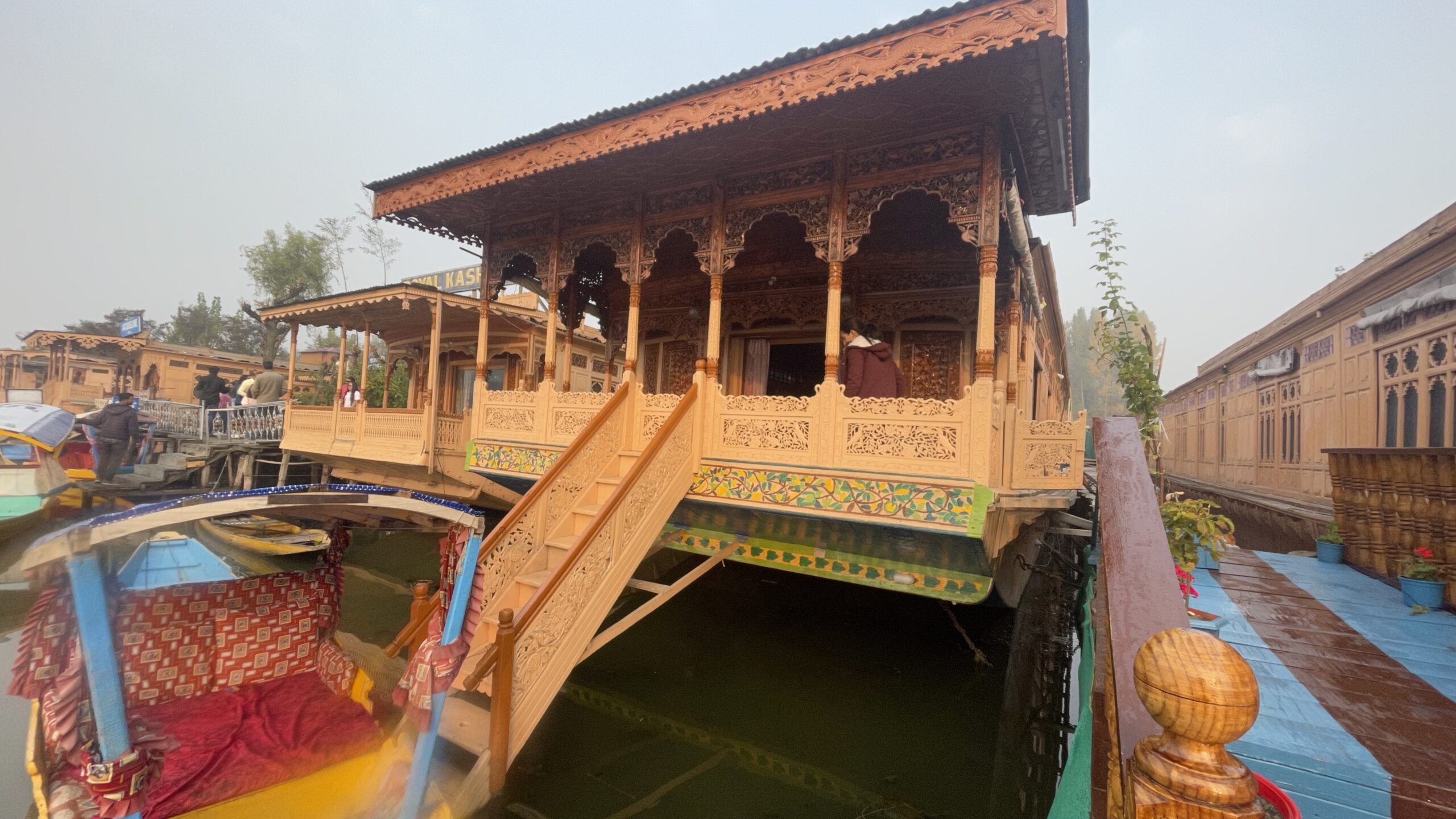
Whether you book a taxi at the prepaid counter or have your houseboat send a car, the destination you want to give is not the houseboat — it is the ghat. Houseboats are on water, and no road reaches them. A driver who is told the boat name may not know it; a driver told a ghat number will take you straight there.
So make sure you have three things before you land: the ghat number, the houseboat name, and a phone number for the boat itself rather than only for an agent. Message your host when you land so somebody starts moving. If you are arriving after dark, say so in advance — the ghats are poorly lit and the crossings are harder to find at night.
Book your stay
We arrange the transfer with the boat
Send your flight details with your dates and we will confirm the ghat, the pickup and the crossing along with the houseboat. Rates on request.
From the ghat to the houseboat
The ghats are numbered stone steps down to the water along the Dal Lake boulevard, with equivalent access points at Nigeen. Your shikara meets you there. The crossing is usually a few minutes, paddled, and your luggage goes in the front of the boat.
A few practical points that make the last hundred metres easier:
- Wait at the ghat, not along the boulevard. From the road one houseboat looks much like another, and yours may be moored behind two others.
- Keep your bags together and hand them down rather than carrying them into the boat. The steps can be wet.
- Step into the middle of the shikara, not onto the side, and sit down before it pushes off.
- If you have limited mobility, say so when you book. Some moorings are easier to board than others and some boats can be reached on foot. This is a real difference and it is worth asking about in advance.
- Confirm the return crossing for your departure day, particularly if you have an early flight. It should be arranged the night before.
The same applies in reverse when you leave: the shikara takes you to the ghat, the car meets you there. Ask your host to book the taxi rather than finding one on the boulevard at six in the morning.
What to have ready before you land
Arrival in Srinagar is easy if you land with five pieces of information and awkward if you do not. None of them take more than a message to obtain, and all of them are worth having offline.
- The ghat number for your houseboat, which is what the taxi driver needs.
- The houseboat name, written down as it is spelled on your confirmation.
- A phone number for the boat itself, not only for the agent who took the booking.
- Your written confirmation, screenshotted rather than sitting in an inbox you may not be able to reach.
- Some cash. Card acceptance is patchy on the water, and the first taxi and the boatman are simpler with notes.
Mobile connectivity is generally fine in Srinagar, but prepaid SIM cards issued in other parts of India do not always work in Jammu and Kashmir, so do not assume your data will come up the moment you land. Download an offline map of the boulevard before you fly, and tell someone at home your houseboat name and ghat number in case they need to reach you through the boat.
Timing your arrival and departure
Arriving in daylight is better in every respect: you can see the lake, the crossing is simpler, and the boat has time to sort out your room and a meal. If you can choose, a late-morning or early-afternoon arrival is ideal.
For departure, work backwards generously. Security at Srinagar airport takes longer than at most Indian airports, the boulevard has traffic at the wrong times of day, and the shikara crossing adds a few minutes at the start. In winter, add a buffer day before any onward international flight; snow delays are common enough to plan around.
Once you have arrived, our Dal Lake guide explains the water you are now living on, and things to do in Srinagar covers what is within reach of the ghat.