Srinagar
Things to Do in Srinagar
Gardens, the old city, the shrines and the viewpoints, with rough distances from the houseboat ghats and a realistic sense of how long each takes.
Srinagar is a compact city wrapped around two lakes and a river, and almost everything worth seeing is within about ten kilometres of the houseboat ghats. Distances below are rough road distances from the Dal Lake boulevard; from Nigeen add a few minutes for most of them. Traffic, not distance, decides how long anything takes.
The Mughal gardens
The gardens are terraced, walled and water-fed, laid out on the slopes above Dal Lake in the seventeenth century, and they are the single most rewarding half-day in the city. They work as a sequence: go to two or three in one trip rather than one a day.
- Shalimar Bagh, roughly 10 to 12 km from the boulevard along the eastern shore. The largest and the most formal, with a long central water channel and chinars down both sides.
- Nishat Bagh, roughly 8 to 10 km, on the way to Shalimar. Terraces climbing straight up from the lake shore, with the best garden view of the water.
- Chashma Shahi, roughly 8 km, smaller and set higher, built around a spring.
- The tulip garden, below the Zabarwan hills near Chashma Shahi, open for a few weeks in spring only.
Allow an hour at each if you want to walk the terraces properly. Mornings are quieter and better for photographs; late afternoon light on the lake side of Nishat is worth timing for.
The old city
Downtown Srinagar, on both banks of the Jhelum, is where the city is oldest and densest — timber and brick houses, bridges, shrines, and the copper, papier-mâché and shawl trades still working in their own lanes. It is roughly 4 to 6 km from the boulevard, and it is best done on foot once a taxi has dropped you.
The Jamia Masjid, with its wooden pillars of deodar and a large courtyard, sits at the heart of it. The Shah Hamdan shrine on the riverbank is one of the most striking timber buildings in the valley. Several of the old bridges are still in daily use, and walking between two of them is the easiest way to see how the city works.
Dress modestly, ask before photographing people, and note that mosques and shrines have prayer times when visitors are asked to wait. Non-Muslim visitors are generally welcome in the courtyards; the inner areas of some shrines are restricted.
Hazratbal and the shrines
Hazratbal stands on the western shore of Dal Lake, roughly 5 to 8 km from the boulevard and closer if you are staying on Nigeen. It is the most important shrine in Kashmir, white marble with a single dome, with the lake on one side and a large open forecourt. Fridays are extremely busy.
Cover your head, remove your shoes at the entrance, and expect separate entrances for men and women. It combines well with a stop at the nearby Nigeen shore or with the drive on to the Mughal gardens.
Pari Mahal and Shankaracharya
Pari Mahal sits on a spur above Chashma Shahi, roughly 9 to 11 km from the boulevard by road. A terraced seventeenth-century pavilion and garden, it is quieter than the lake-level gardens and has the widest view over Dal, the city and the hills behind. Late afternoon is the time to be there.
Shankaracharya temple stands on the hill the locals call Takht-e-Sulaiman, directly above the boulevard, roughly 6 to 8 km by the winding access road. The temple is ancient and small; the reason to go is the view straight down onto Dal Lake and the houseboats. There are steps at the top, and security checks on the way up, so phones and bags may be restricted.
Both are best on a clear day, and both can be combined with the gardens in one long afternoon with a car.
Shikara rides
See the city from the water as well
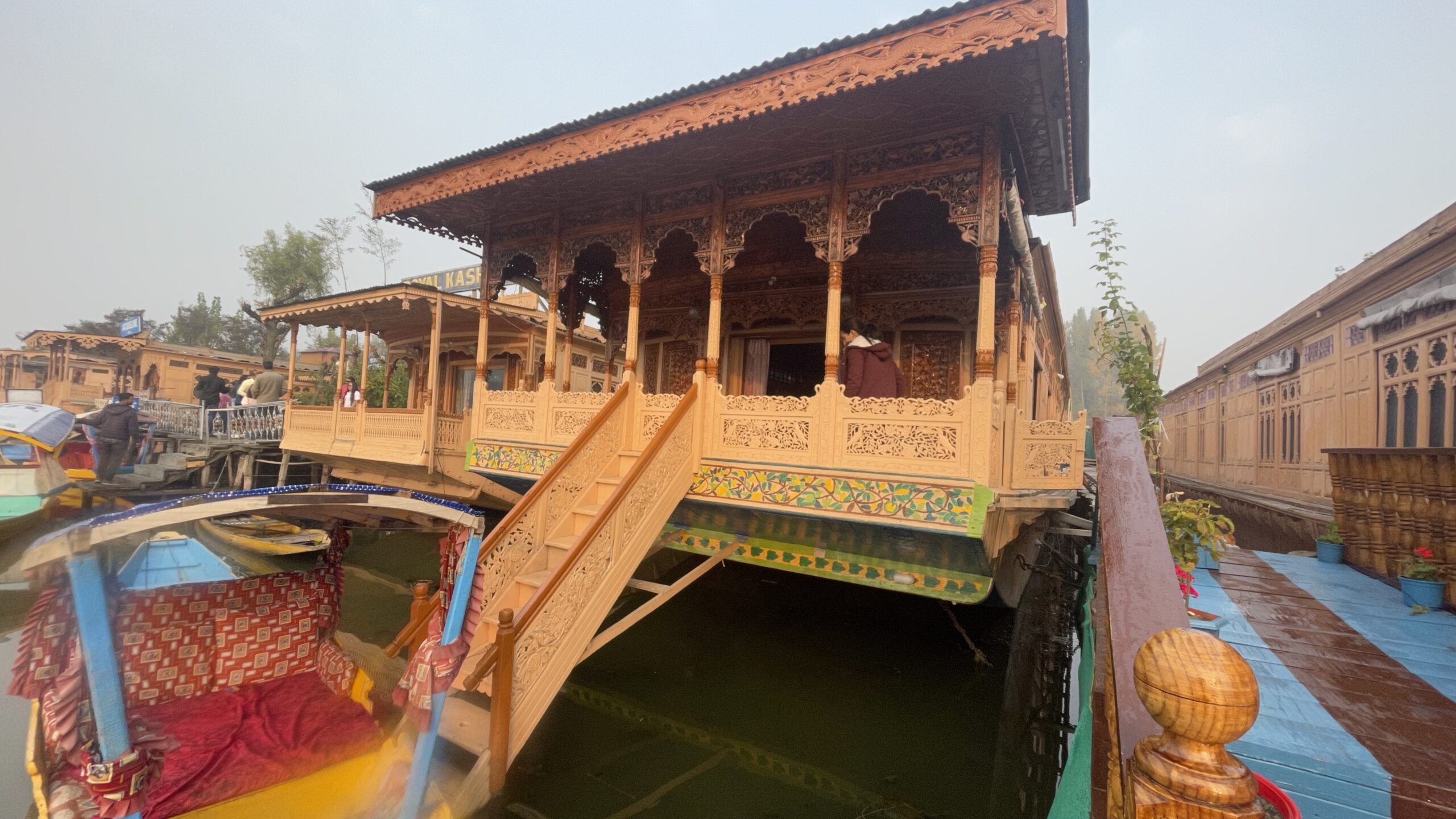
Half the sights above look better from a boat than from a road. A shikara ride can be added to any houseboat stay, including an early start for the floating market.
The floating market and the lake
The vegetable market on Dal Lake happens on the water, at dawn, when growers from the floating gardens bring produce out in flat-bottomed boats and trade among themselves in a cluster of boats in one of the inner basins. It is not a performance for visitors and it is over early.
You need to leave your houseboat before first light to see it, which means arranging the shikara the night before. It is roughly twenty to forty minutes of paddling from most moorings. Our Dal Lake guide explains where it happens and what else is out on the water at that hour.
Later in the day the lake itself is the attraction: the lotus beds in summer, the water villages and floating gardens, the channels between the causeways, and the long line of houseboats along the eastern shore.
Half-days and day trips
If you have more than three nights, one day out of the city is worth it. All of these are done with a car and driver and returned the same day.
- Gulmarg, roughly 50 km west. Meadow in summer, ski resort in winter, with a gondola up towards Apharwat.
- Pahalgam, roughly 90 km south-east, along the Lidder river, with walks and pony rides in the side valleys.
- Sonamarg, roughly 80 km north-east on the road towards Ladakh, with glacier views. Closed in deep winter.
- Pampore, roughly 15 km south, the saffron belt; the fields flower for a short period in late autumn.
- Yusmarg, roughly 45 km south-west, quieter than the other three and good for a short walk.
Distances are short but the roads are slow, and one of these fills a day comfortably. Two in a day is possible only if you are prepared to spend most of it in the car.
Getting around the city
Taxis and autorickshaws cover Srinagar, and both are easiest arranged through your houseboat rather than hailed at a ghat. For a full day of sightseeing, a car with a driver is the sensible option: the gardens, Pari Mahal and Shankaracharya are all on slopes above the lake and stringing them together on foot is not realistic.
Within the lakes, the shikara is the local bus as much as the tourist attraction. Agree where you are going and for how long before you step in, and settle the return as well as the outward trip. Walking is genuinely rewarding in exactly two places: the boulevard along the lake, and the lanes of the old city.
Eating and shopping
Kashmiri food is worth going out of your way for: rogan josh, gushtaba, haak, dum aloo, and rice with everything. Wazwan, the multi-course feast, is a banquet tradition rather than a restaurant menu, though some restaurants serve a shortened version. Kahwa, the green tea with saffron, cardamom and almond, will be offered on your boat repeatedly and you should say yes.
For shopping, the crafts to look at are pashmina and kani shawls, carpets, crewel embroidery, papier-mâché and walnut wood. Buy in the city rather than from a boat that has come alongside, look at the same item in two or three places, and ask your host where they would go. Prices quoted on a verandah are not market prices.